I Connected Claude Code to TradingView. Here's What Held Up.
Claude Code reading real TradingView chart data to check a trading strategy's conditions automatically, how to set it up, and the honest update on the strategy afterward.
Most AI trading advice is useless. You paste a chart screenshot into a chatbot, ask "is this a good buy?" and get a confident guess.
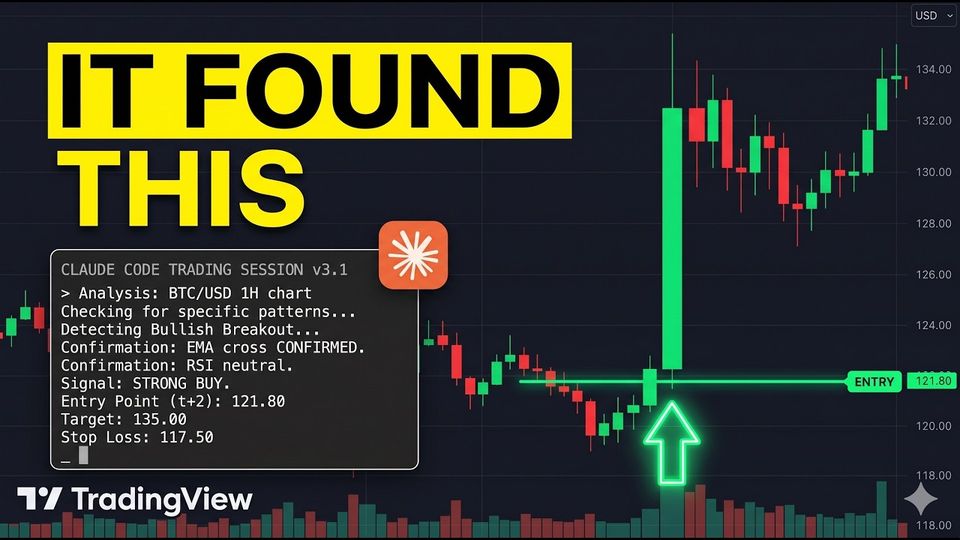
So I built something different: Claude Code connected directly to TradingView. It doesn't look at screenshots. It reads the actual chart data and checks whether my strategy's rules are met.
The problem it solved
I had a strategy for Bitcoin on the one-hour chart, called BH1. It needed six conditions to line up across two timeframes before it would take a trade.
Checking that by hand every hour doesn't work. You miss setups, you enter early, and emotions take over.
So I asked Claude to do the checking. "Run the BH1 check on Bitcoin one hour" returns all six conditions and whether each one passes. It works on any coin I ask about, and every morning at 6am I got a list: which coins have a setup, which don't, no emotion involved.
That's the key difference. It follows rules, not an AI's opinion.
How to set it up
- Install Claude Code, Anthropic's coding tool. Get the desktop version.
- Install the TradingView MCP server. It's one command, and it connects Claude to your TradingView data.
- Open the TradingView desktop app. It has to be the desktop app, not the website.
- Ask Claude about your chart. That's the whole setup.
From there I used Freqtrade inside Claude Code to paper trade the strategies, meaning real-time prices with fake money, before risking anything real.
The honest update
The setup was the easy part. I said so in the video: the hard part is a strategy that actually works.
BH1 looked good in a three-month backtest. Then it went live, the results didn't hold up, and on April 26 I shut it down for good.
The tool did exactly what it was built to do: it checked the rules perfectly, every hour, without emotion. The rules themselves were the problem. A backtest is a hypothesis, not proof, and the only way to find out is to test it live with small stakes and be willing to kill it.
What I'd take from this
- Automated rule checking is genuinely useful. It removes the "I'll just check one more time" habit and the emotional entries.
- AI doesn't give you a strategy. You bring the rules, and the AI applies them consistently.
- Paper trade before real money, and set a kill date. If a strategy hasn't proven itself by then, it's done.
Why this matters outside trading
Replace "strategy conditions" with "a qualified lead" or "a complete client file" and you have most of the AI systems I build for businesses: clear rules, checked automatically, every time, with a person making the final call.